During these years a major fire destroyed a great portion of the city. Immediately after the fire, the Jewish community added an important synagogue built of bricks. This was the Brisk Famous Synagogue, which survived until 1840, when it was demolished to make way for the Brest Fortress.
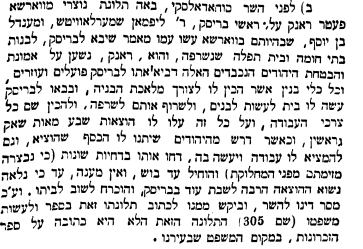
Rabbi Feinstein, in his Ir Tehila (1886), reports a massive fire in Brest in 1567. (Unfortunately, he gives no source.) He cites Russko-Yevreiski Archiv, vol. 2, document No 305, to give details of what happened next, construction of a new synagogue made of bricks:
The text identifies the contractor, describes the delays, and explains how the matter resulted in a lawsuit. The English translation:
...
A Christian of Warsaw, Peter Ronk, complained before minister
Sukhadalski about the leaders of Brisk: Lipman
Shmerlavitch and Mendl,
son of Yosef. When
they were in Warsaw they
made a deal with him to come to Brisk to build stone houses and a
prayer house that was burnt down.
Ronk, based on the promise of these honorable Jews, brought with
him to Brisk workers and helpers and tools to make bricks for the
house [synagogue]. He spent on these preparations 700 S"g.
When he demanded to get this money and start working he was turned
down with various excuses (because they had this dispute between
them) and he waited in vain.
He [Ronk] could not wait any longer in Brisk
with his mounting expenses and was forced to return to his home.
He sued them before the minister who registered the complaint in
the memory-book in the court house of our town.
Citing Russko-Yevreiski Archiv, vol. 2, document No. 305, the Jewish Encyclopedia also tells us that in 1569, a brick synagogue and brick houses were (in the process of being) built, as indicated by a lawsuit of the contractor against the Jews for not paying him in time.
In Pinkas Hakehillot Polin fix link (1973; translated to English in 1990) we read:
A year later in 1568, the city burnt down and [to support the victims] the king, Zygmund Augustus, exempted all the residents, including the Jews, from paying one third of their taxes for the next nine years.
He also encouraged them to build their houses from bricks.
The major tax collectors of that time, Lipmanson of Shmarye, and Mendel, son of Isaac invited an architect from Warsaw to design and build homes and the magnificent synagogue.
The synagogue building was considered at that time to be the most beautiful in Poland-Lithuania. This synagogue stood until 1842.
In sum, we have reasonably good evidence of a conflagration in Brest ~1568, which consumed at least one synagogue –probably one built of wood. The Jews of Brisk asked for royal help to rebuild their homes and to build a replacement synagogue of brick. Construction was delayed for some unknown time, but the synagogue was eventually built. That synagogue was known for its beauty and it probably survived until the 1840's.