The article Childhood Memories of Morris Gevirtz in the Wysokie-Litewskie/Volchin Yizkor Book [the minimal Yizkor Book for Volchin and Wysokie-Litewskie, here] contains this text:
The translation (by H. K.) is as follows:
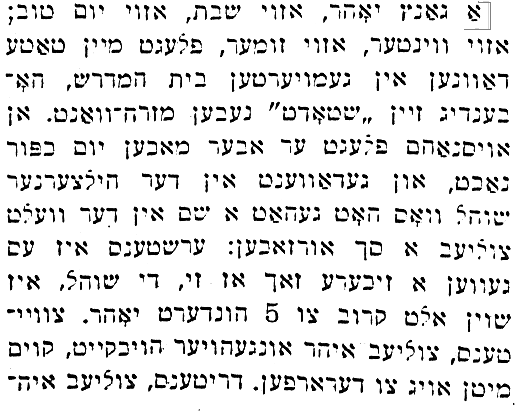
A whole year as on Sabbath as on holiday as in winter, as in summer, my father used to pray in the [gemoyerten [געמויערטע ן = [moyer is a "wall": a moyerer is a brick-layer] solid-built Beit Hamidrash [a house of studying but also for praying] where he had a reserved-place near the Mizrach Wall. He made an exception for the Yom Kippur eve, and prayed in the wooden shul (synagogue) that had made a name in the world thanks to many facts: First of all it was a certainty that it was already 500 years old; Secondly, for its amount of height that the eye could hardly reach; thirdly, thanks to the artistic works painted on its walls and on its ceiling, as good as the countless writings on the walls mutely telling of historical events and memories full of importance.
Gevirtz recounts that the Synagogue of Volchin where his father used to
pray was the only one in that village. Contrary to what he told,
it was not built of wood, but of burnt-red bricks coated with
plaster. I photographed the synagogue in 1997 and, let me be clear,
it was not constructed of wood. On some portions close to the ground the
cover-plaster had disappeared and the red bricks showed.
The
previous year or before, visitors photographed the building and it
looked like a store-house for building material.
Dov: I
am certain there was only one synagogue. Shmuel Englander told me the
same. A woman my age who came from Volchin to Israel when she was 8 1/2 years old was positive that there was only one synagogue, made of
brick and stone. Recently I telephoned her to find
out what she remembers about this issue. She said: Maybe there was a wooden one once and was
burnt down by fire. I can't believe that the goyim --who had just one
prayer house for each Christian sect-- would permit two synagogues.
As
for Synagogue vs. Beit Midrash – in the small communities the two
words were used synonymously.
| Translator's Note: I translated the Yiddish word for word, to make clear the exact meaning of the words and the way Yiddish “talks” to you. The meaning of the adjective געמויערטען that precedes Beit Hamidrash is “solid-built with concrete or bricks”. My conclusion is that there certainly was an old wooden synagogue and that people prayed in the solid-built Beit-Midrash as well. I can't imagine why Dov's mother did not tell him about the second, wooded synagogue and why Shmuel Englander told Dov-- according to Dov's recollection-- that there was only one synagogue. I assume that it was destroyed by fire. |